Thursday, December 01, 2011

Image retouching detection tool


Wired reports: [edited]

A new photograph-analyzing tool quantifies changes made by digital airbrushers in the fashion and lifestyle industry, where image alteration has become the norm.

In a Nov. 28 Proceedings of the National Academy of Sciences study, Farid and doctoral student Eric Kee debut a computational model developed by analyzing 468 sets of original and retouched photographs. From these, Farid and Kee distilled a formal mathematical description of alterations made to models' shapes and features. Their model then scored each altered photograph on a scale of 1 to 5, with 5 signifying heavy retouching.

To validate the scores, Farid and Kee then asked 50 people randomly picked through Amazon's Mechanical Turk task outsourcing service to evaluate the photographs. Computational and human scores matched closely. "Now what we have is a mathematical measure of photo retouching," said Farid. "We can predict what an average observer would say."

- - - - -

Brett's 2p'orth: The full article is worth a browse, especially the 'before/after' image examples.
------------

Wednesday, November 30, 2011

Ice Cream Sandwich


Register Hardware have produced a succinct hands-on review of Android's latest (V4.0) release, AKA 'Ice Cream Sandwich' (ICS).

Excerpts follow:

"In terms of design, ICS is a quantum leap forward over previous incarnations of Android. Taking inspiration from iOS and WinPho 7, the UI is now replete with visually pleasing animations that give the impression that the UI is alive to your touch."

"The menu button now migrates around the screen depending on context and app. Sometimes it appears in the app menu bar at the top, sometimes at the bottom and sometimes next to the running apps window in the system bar. Call me old fashioned but I like a menu button that stays in one place.

"The virtual keyboard may not look that different from the v2.3 Gingerbread implementation but it’s much easier to use and now has that same degree of uncanny accuracy the iOS keyboard is blessed with, complete with pop-up letters to tell you what you have hit."

"The new photo gallery not only looks better but it works faster. Much faster. Assuming your data connection is up to snuff, your Picasa gallery thumbnails appear as fast as they do from local storage. The system’s ability to see newly added media has also been improved."

"The Android web browser has also been given a good going over. It’s gained a bucket load of extra speed and, at long last, an option to render web pages in their desktop format by default. Pages can now also be saved for off-line reading directly from the browser menu."

"Navigate to the camera app and you move from the Gingerbread stone age to the Ice Cream Sandwich 21st century. The new interface is much improved and comes with a built-in panorama mode that works surprisingly well. Tap the screen while shooting a video and the camera takes a still capture."

"When it comes to wholly new features there are a couple of interesting additions to the Android playbook. Pride of place goes to Face Unlock which uses facial recognition to unlock the handset. Impressively, the system never failed to recognise me as the authorised user but equally was never fooled by anyone else’s fizog or even by a large picture of yours truly."

"With Ice Cream Sandwich Android moves its game on by the greatest degree yet. In terms of look and feel it’s now hard on the heels of iOS and well ahead of WinPho 7.5 and BlackBerry 7."
------------

Tuesday, November 29, 2011

Pi budget computer


The Register has published an excellent article on this British-designed computer.

Excerpts follow:

"the most remarkable thing about this low-power credit card-sized computer is its price tag: little more than £20 for a fully functional system capable of, among many things, 1080p video playback and hardware-accelerated graphics."

"The Pi is powered by a 700MHz ARM-compatible processor with hardware support for OpenGL ES 2.0 and Blu-ray-grade playback (1080p30 H.264), and features 256MB of RAM, TV, HDMI and audio outputs, a USB port, a Flash memory card slot, 100MBit Ethernet and a number of I/O pins for a serial port and general purpose hacking. This is all fitted on a low-cost 85.60mm x 53.98mm board that's about 20mm high, weighs 40g and is powered from a 5V supply."

"The reliance on removable boot memory ensures the kit can't be bricked, not even by the most inquisitive or vindictive schoolchildren."

"The RaspberryPi Model A and Model B (a reference to the BBC Micro) are expected to go on sale in December priced $25 and $35 (16 and 22 quid respectively). The Model A will have 128M of RAM and no Ethernet, whereas the Model B will be produced in larger numbers and have 256M of RAM plus 10/100MBit networking."
------------

Monday, November 28, 2011

LUCA


New Scientist reports: [edited]

ONCE upon a time, 3 billion years ago, there lived a single organism called LUCA [Last Universal Common Ancestor, Ed.]. It was enormous: a mega-organism like none seen since, it filled the planet's oceans before splitting into three and giving birth to the ancestors of all living things on Earth today.

This strange picture is emerging from efforts to pin down the last universal common ancestor - not the first life that emerged on Earth but the life form that gave rise to all others.

The latest results suggest LUCA was the result of early life's fight to survive, attempts at which turned the ocean into a global genetic swap shop for hundreds of millions of years. Cells struggling to survive on their own exchanged useful parts with each other without competition - effectively creating a global mega-organism.
------------

Friday, November 25, 2011

Fujifilm X-S1


Digital Photography Review reports: [edited]

Fujifilm has announced the X-S1, a premium-grade superzoom compact. The X-S1 is part of the company's high-end 'X Series' and is built around the same 12MP 2/3" CMOS sensor as the X10 compact.

Despite the comparatively large sensor, it manages to include a 26X 24-624mm equivalent F2.8-5.6 zoom lens. It also features Raw shooting, a 1.44M dot electronic viewfinder and 460,000 dot rear LCD along with a rubberized coating and metal dials to emphasize its premium 'Made in Japan' status.
------------

Thursday, November 24, 2011

Can the iPhone 4S replace a 'real' digital camera?


Infinite Loop have prepared a compare/contrast review of the image-taking performance of an Olympus XZ-1 point and shoot, a Canon 20D DSLR with EF-S 10-22mm lens, an iPhone 4S and a Samsung Galaxy SII.

Edited summary:

"In real life use, each camera has a mix of benefits and drawbacks. The iPhone 4 was our previous favorite in smartphone cameras, and the iPhone 4S improves on that. The lens is a bit sharper and the hybrid IR filter seems to improve color rendering and possibly white balance. The new sensor also seems to have slightly less noise, better dynamic range, and three million more pixels to work with."

"The combination of an updated sensor and the dual-core A5 processor also make the iPhone 4S much faster to start up and take pictures. It was nearly as fast at launching, focusing, and snapping sequential images as the Olympus XZ-1, and certainly faster than previous compact cameras we have used."

"For snapshot purposes, the iPhone 4S is comparable to the 8MP Canon 20D when it comes to image quality. But that comparison is a little unfair — you can easily achieve better results with newer DSLRs in terms of exposure, noise, and megapixel count. What you can't do with any DSLR, though, is (again) slip it into your pants pocket. Lenses that have as bright an aperture as the iPhone 4S's f/2.4 will also either be limited to a single focal length or generally be much larger and heavier than the lightweight kit lenses that many users have."

"As we said at the outset, every camera choice comes with its own set of compromises and won't suit every individual photographer. Still, we have no qualms recommending the iPhone 4S as great alternative to compact, point-and-shoot cameras. It can take great photos when travelling or out with friends. Since it's also your phone, you'll always have it with you, so you may be able to grab shots in situations when you might not be able to otherwise take pictures at all."
------------

Wednesday, November 23, 2011

Free Fonts: Novecento


behance.net reports: [edited]

This is the revised and improved version of Novecento, an uppercase-only font family inspired on European typographic tendencies between the second half of 19th century and first half of the 20th.

It looks rational and geometric. However, it is optically corrected and balanced.
This font face is designed to be used mostly for headlines, visual identities or short sentences, both in big and small sizes.

Novecento is available both in opentype format (.otf) and as a webfont (@fontface), with 6 weights available free.
------------

Tuesday, November 22, 2011

Scrabble Letter Mugs


The Spoon Sisters reports: [edited]

There's a colourful hidden surprise inside each mug, and a letter distribution table on the other side. Ceramic. Holds close to 350ml.

Price: $11.95 each. Full alphabet: $310.70.
------------

Monday, November 21, 2011

Breaking the yachting sound barrier


New Scientist reports: [edited]

Along a stretch of Namibia's wind-blasted Atlantic coastline, one man is about to try to sail faster than any sailor has ever done before. This attempt to set a world record requires technical expertise, courage and luck. It will take place in the Vestas Sailrocket 2, which barely even looks like a boat and is, astonishingly, based on a design that is 40 years old.

For the past few months, the team has been making trial runs. If their innovative design hits 60 knots (111 kilometres per hour), it will change the future of speed sailing.

"Going from 50 to 60 knots is like breaking the sound barrier," says the boat's pilot Paul Larsen.

But it won't be easy. In 2008, the first version of the boat flipped out of the water in a spectacular accident just as it was approaching record-breaking speeds.

Click here for latest updates.

If you Twitter, they have a Twitter Feed.
------------

Friday, November 18, 2011

National Geographic Photo Contest 2011


The Atlantic reports: [edited]

National Geographic is currently holding its annual photo contest, with the deadline for submissions coming up on November 30. For the past nine weeks, the society has been gathering and presenting galleries of submissions, encouraging readers to vote for them as well.

National Geographic was kind enough to let me choose among its entries from 2011 for display here on In Focus. Gathered here are 45 images from the three categories of People, Places, and Nature, with captions written by the individual photographers.
------------

Thursday, November 17, 2011

Fujifilm FinePix X10


This recent offering from Fujifilm is getting excellent reviews.

For £500 you get a pleasingly 'retro' looking body, an optical viewfinder, a bright (f2.0-2.8) 28-112mm manual zoom lens, fast focus and decent low-light performance.

For ePhotozine's review (including sample images) click here

For more sample images, courtesy of Digital Photography Review click here
------------

Wednesday, November 16, 2011

Trumstand


Firebox reports: [edited]

Weighing in at a hefty 4.3kg the Trumstand’s curvaceous horn is crafted in brass and plated with nickel or gold powder, giving it the look of an antique gramophone. Even the base is made from a machined block of aluminium.

You won’t find any woofers or tweeters in the Trumstand because just like an antique gramophone the sound is generated purely from resonance created by the trumpety shape of the horn. Yes, there is a power cord but that’s only there to charge your gizmo when it’s docked. The sonic result? Amazingly vivid aural ambrosia with a hint of old-school gramophone warmth.

£1500, including delivery.
------------

Tuesday, November 15, 2011

Graphene, the new silicon?


The Guardian reports: [edited]

Somehow it seems appropriate that the government might be basing some of its hopes for the economy's recovery on a substance that is one atom thick. The substance in question – graphene – 200 times as strong as steel, seems to some designed to carry the weight of almost anything – but George Osborne's Plan A? That would indeed make it a miracle material.

Nevertheless the chancellor made a detour from the Tory conference in Blackpool in September to visit Manchester University, graphene's spiritual home, and to announce a £50m investment. Graphene is claimed by some as an innovation that will prove as revolutionary as the silicon chip, or even plastics, both of which it may supersede.

Sitting in his lab at the university, Konstantin Novoselov one half of the 2010 physics Nobel prize-winning team that "discovered" graphene, runs through the superlatives of his material – uniquely strong and flexible and the best conductor of electricity yet found.

Graphene may be formed of unique bonds, but the synergy between research and application, between university and industry is still nowhere near as tight as it might be. I imagine, universities and corporations are throwing money at graphene research in other parts of the world?

"Yes," Novoselov says, "but money is not the only thing. Before the £50m we had no more than any other lab, but we still kept at the front of this. It's more time than money." If you think that you can make a new kind of transistor and put it into your computer straight away, he suggests, then you are wrong. How to integrate this into existing technology let alone allow it to begin to shape new technology will take years if not decades. He points to the example of silicon. "The first transistor was maybe 1947, silicon appeared six or seven years later and then it was another 10 or 20 years before integrated circuits." 2D technology may take even longer to become properly commercial, but he has no doubt that it will.

"The real excitement at the moment is the way we can now layer graphene with different 2D materials," he says, "with each layer having different properties." The stacking means that in theory it will be possible to design materials with the properties to meet any needs. "You tell me 'I want blue and highly conductive and bendy' and we can make it."

To a certain degree, he suggests, the only limits to graphene may be those of imagination. "We still tend to think of how this material might be used in the form of current objects. We can imagine, say, a 2D layered photodetective material, with a solar cell and transistor combined which would allow you to make a very thin plastic touchscreen that generated its own power."
------------

Monday, November 14, 2011

Shapecatcher


shapecatcher.com reports: [edited]

You know what some character looks like, but you've forgotten its name or its Unicode code point. Now what do you do? Shapecatcher is a new website, that helps you to find specific Unicode characters, just by sketching their shape. Currently about 10000 of the most important Unicode characters are compared to your sketch and are analysed for similarities.
------------

Friday, November 11, 2011

Smartphone OS Shootout


Register Hardware has published a compare/contrast review of the four dominant smartphone operating systems.

Edited verdict:

None of the operating systems get it staggeringly wrong. RIM's BlackBerry is starting to look long in the tooth - sometimes I thought I'd slipped back into Windows Mobile - and, like Android, is prosaic rather than pretty.

Undoubtedly, iOS is the most aesthetically pleasing phone OS.

WinPho is the newest OS, so it has some catching up to do to match the others for functionality. But it's getting there. And, for the moment at least, it's pleasantly quick.

Apple's excellent content shops and playback capabilities are sufficient to satisfy anyone unopposed to or disinterested in the walled garden.
------------

Thursday, November 10, 2011

Shape Type


Shape Type tests how well you can restore a crippled character to its intended proportions. More difficult than you might think.
------------

Wednesday, November 09, 2011

Chevrolet Speedometers 1941-2011


Christian Annyas has published a lovely collection of Chevrolet speedometers. I heartily concur with his comments, including...

"The design of speedometers hasn’t changed much over the decades. Recently, however, there’s a trend towards digital meters. They’re probably supposed to look fresh and new, but due to the use of digital stopwatch-like typefaces they actually look extremely primitive and dated."
------------
Tuesday, November 08, 2011

Savannah III Rocking Chair


Jolyon Yates makes beautiful things with wood. This is one of my favourites.

To view more of his work, click here.
------------

Monday, November 07, 2011

Panasonic DMC-GX1


Digital Photography Review reports: [edited]

Panasonic has announced the Lumix DMC-GX1, an enthusiast-oriented Micro Four Thirds camera that bears more than a passing resemblance to the Lumix DMC-GF1.

The GX1 sports a 16MP 'Live MOS' sensor, a maximum ISO sensitivity setting of 12,800, a touchscreen interface and a revamped AF system. The GX1 is also the first camera compatible with Panasonic's brand new high-resolution LVF2 viewfinder, sold separately.

The GX1 is available in a black or silver body with MSRP starting at $699.99 without lens.

For a hands-on preview and video click here.
------------

Friday, November 04, 2011

PlugBug


twelve south reports: [edited]

PlugBug is a 10W USB wall charger that piggybacks onto your MacBook Power Adapter, creating an all-in-one, dual charger for MacBook + iPad or iPhone. That means you can charge your MacBook + iPad or iPhone at the same time using one wall outlet.

Price: $34.99
------------

Thursday, November 03, 2011

Jawbone Up


Mashable reports: [edited]

If Jawbone has its way, you’ll soon be wrapping this $99, bendable, waterproof gadget around your wrist, tracking your health with it — and hardly ever taking it off.

It syncs with Jawbone’s Up app for iPhone (an Android version is in the works) via an audio jack hidden under that silver cap at the end. It also charges via the audio jack, which you’ll need to plug into a USB connector every ten days or so.

What is the wristband tracking? In short: sleep and exercise. It looks for micro-movements at bedtime and can tell when you’ve fallen asleep. It will wake you with gentle vibrations in the morning instead of music or noise. It can track whether you’re in light or deep sleep, and will wake you within a certain window of time, when your sleep is at its lightest.

The Up will also track your movements throughout the day. It’ll capture all the little moments of exercise you don’t think you’re getting, as well as your deliberate workouts.
------------

Wednesday, November 02, 2011

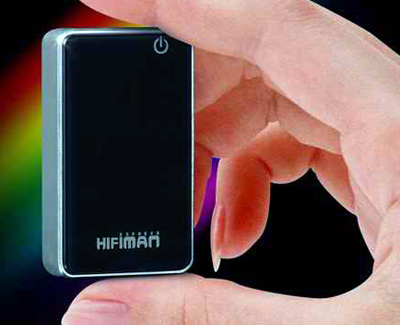
Hifiman Express HM-101


CNET reports: [edited]

I wasn't expecting much from the Hifiman Express HM-101; it's just a $39 outboard USB digital-to-analog converter and headphone amplifier. Well, this tiny USB-powered device definitely pumped up the sound of my Audio Technica ATH-M50 headphones. Sure, the Mac's sound is perfectly acceptable - until you compare it to something better. The Express is a lot better.

It also has a line-out 3.5mm jack you can run to a set of desktop-powered speakers. Switching over from the computer's headphone jack to the Express, the first thing I noticed was that the Express could play a lot louder.

When playing drummer Ginger Baker's "Going Back Home" CD at equal volume levels from the computer and the Express, the Express unleashed more of the drummer's hard-hitting dynamics.

And it's not just power; I heard a difference when I played Gillian Welch's gorgeous "The Harrow & the Harvest" CD; her vocals and banjo were clearer over the Express. The background noise level was lower, so I felt closer to Welch's performance.
------------

Tuesday, November 01, 2011

Royal Society Journal Archive


The Royal Society reports: [edited]

The Royal Society has announced that its world-famous historical journal archive - which includes the first ever peer-reviewed scientific journal - has been made permanently free to access online.

Around 60,000 historical scientific papers are accessible via a fully searchable online archive, with papers published more than 70 years ago now becoming freely available.

Philosophical Transactions had to overcome early setbacks including plague, the Great Fire of London and even the imprisonment of Oldenburg, but against the odds the publication survived to the present day. Its foundation would eventually be recognised as one of the most pivotal moments of the scientific revolution.

Treasures in the archive include Isaac Newton’s first published scientific paper, geological work by a young Charles Darwin, and Benjamin Franklin’s celebrated account of his electrical kite experiment.
------------

Monday, October 31, 2011

BTS-PHF38 Bluetooth Wireless Headphones


For a 'No Need To Cry If It Gets Lost Or Broken' (NNTCIIGLOB™) Bluetooth headset, look no further.

At £22.46 (inc p&p) it allows you to listen to music, answer calls on your smartphone. And when not in use, it folds into a (provided) drawstring bag. And the (provided) charging cable is a standard 'mini-usb' connection, so if you forget/lose it, you'll have no problem finding another one.

The sound quality is very listenable, although the 'closed' earpieces leak a lot more sound than the Sennheiser MM 400 unit I reviewed.
------------

Friday, October 28, 2011

Sennheiser MM 400 Bluetooth Headphones


My regular searches on audiophile forums for a pair of portable wireless headphones that sound as good as wired headphones had me move towards purchasing a pair of MM 400s, but the £200 list price seemed a bit steep.

A half-price offer on Amazon encouraged me to take the plunge, and a couple of days later the familiar brown & black cardboard package arrived. First impressions were good. They are a well-built, with soft leather padding on the ear cups and headband. When folded they fit neatly into the provided 11 x 18 x 5cm nylon carrying case, which has a side pocket for cables.

Charging is via your computer's USB port, or with the provided mains charger. The headphones have a non-standard socket, meaning you have to use the Sennheiser-supplied cable, and the cover for the socket is flimsy and poor-fitting, one of the plastic hinges on it has already broken after just a few months use. Claimed operating time is 10 hours, but if the batteries expire, you can connect directly using the supplied cable.

Pairing to my iPhone was simple and quick. The closed earpieces are comfortable, and keep the sound extremely well contained. The volume (like all Bluetooth headsets I have used) won't go as loud as a wired pair, but is perfectly adequate.

The sound quality is not as detailed as the B&W P5s but the overall quality is involving and enjoyable to listen to for long periods of time. And despite being closed, the earpieces remained comfortable.

The play/pause/skip/volume controls on the right earpiece all work efficiently and mean that you can leave your iPhone in your pocket/bag most of the time. The Bluetooth reception is the best of any headset I have used, with only the occasional 'blip'.

I am also pleased to report that they stay firmly in place on my Sunday 4-mile runs, although the isolating effects of the closed earpieces does mean you have to be extra careful when crossing roads!

Although I don't use my iPhone much as a phone, the couple of times when incoming calls have occurred, the pause/resume buttons worked fine, and the microphone picked up my voice just fine.
------------

Thursday, October 27, 2011

Nokia Lumia 800


Register Hardware reports: [edited]

Nokia has officially launched its Windows Phone range, kicking the line off with the Nokia Lumia 800.

As expected, the 3.7in, 1.4GHz phone resembles the N9 but runs Windows Phone 7.5 Mango, through which the Finnish outfit has included an array of features unique to Nokia.

One of these is Nokia Drive, the company's navigation system. Users can download maps to save on roaming charges, get a 3D view of the area and navigate with voice control.

Then there's Nokia Music, a platform for all that jazz. This includes Mix Radio, which throws up preset music mixes free with no subscriptions or logins required. These can also be taken offline for times with no signal.

Vodafone, Three and Orange have already confirmed they will offer the 800, as have Carphone Warehouse and Phones 4U, who both have the handset available from free on £31-per-month contracts. Pay as you go versions are available for £450.
------------

Wednesday, October 26, 2011

Nest


Technologizer reports: [edited]

Tony Fadell took an idea he had for a new gadget to Apple. It was a pocket-sized hard-disk MP3 player. Apple was impressed – and, just over a decade ago, released Fadell’s creation as the iPod.

While Fadell was working on his house, he had a new brainstorm. Why not take the thermostat – one of the most boring devices on the planet, and make it interesting?

Inspired, he co-founded a company called Nest Labs. It’s announcing its creation, the Nest, which it plans to ship in November for $249.

Unlike most modern thermostats – the Nest is a sophisticated piece of consumer electronics. Inside the metal ring you spin to control it is a round color LCD. It’s also got Wi-Fi and embedded motion detectors, allowing it to have a sense of what’s going on around it.

It can pay attention to its surroundings and turn down the heat automatically when it notices you’re not around.

As you adjust the temperature, it can pay attention, learn, and start to adjust it itself to mirror your habits.

It allows you to control it remotely over the Web or using an iOS app.

When you set it to a particular temperature, it tells you how long it’ll be until it reaches it.
------------

Tuesday, October 25, 2011

MacBook Pro range upgraded


The 13" MacBook Pro now comes with 2.4GHz and 2.8GHz processors, up from 2.3GHz and 2.7GHz. The standard hard drive sizes have been increased from 320GB and 500GB to 500GB and 750GB.

The 15" models have been given 2.2GHz and 2.4GHz processors, replacing the 2.0GHz and 2.2GHz processors in previous models. The graphics cards have also been updated — the 2.2GHz gets an AMD Radeon HD 6750M with 512MB GDDR5, and the 2.4GHz version gets an AMD Radeon HD 6770M with 1GB GDDR5.

The 'base' 17" MacBook Pro has a 2.4GHz processor, 750GB hard drive and an AMD Radeon HD 6770M with 1GB GDDR5.

Prices remain unchanged, starting at £999, although if you're visiting the US you could pick up a shiny 13" MacBook Pro for £250 less.
------------

Monday, October 24, 2011

Michael Winslow performs Whole Lotta Love


AKA, Sgt. Larvelle 'Motor Mouth' Jones in the Police Academy series.
------------

Friday, October 21, 2011

LED lighting


I dislike conventional 'energy saving' bulbs, their long warm-up times annoy me, and I don't like the quality of the light even when they are glowing at full strength.

LED lights reach full brightness instantly, last for ages, sip energy and run cool. But up until recently they have suffered from high initial price, and the quality of the light has been too direct and 'blue' for most tastes.

From the excellent reviews on Amazon.com of the $179 Beacon 600s pictured above, it would appear that the light-quality issues are being conquered. And the predictions are that, like flat screens, prices will tumble over the next couple of years.
------------

Wednesday, October 19, 2011

Bowers & Wilkins P5 Headphones


I recently got the chance to borrow a pair of B&W's high-end (£250) 'designed for iPhone/iPod' headphones. They are an 'open' design, meaning they sit on your ears rather than enclosing them. The advantage of this is that they allow you to hear what is going on around you. The disadvantage is that they allow other people to hear what is on your iPhone/iPod's playlist.

The earpieces/headband are covered with soft, comfortable leather. First impressions of the sound quality is of a pleasant, clear and open sound, but lacking in bass. However, after half-an-hour of listening, you begin to notice intricate details in the songs and become involved in the music. A particular highlight was walking down Regent Street on a busy Friday evening, with the music from the headphones mingling with the sounds of cars and revellers in a way that gave the walk a surreal 'I'm starring in my own music video' quality.

The volume rocker on the wire is useful if you listen to a wide range of music, allowing you to boost classical sections and mute the death metal tracks without having to take your iPhone/iPod out of your bag/pocket.

They were comfortable over long periods of use and remained firmly in place while being jostled on Tube trains and during brisk walks along Oxford Street, though not when running across busy roads.
------------

Tuesday, October 18, 2011

iPhone 4S - First Impressions


My 64GB iPhone 4S arrived yesterday morning.

Transferring the O2 microSIM and the 28GB of information that had previously resided on my iPhone 4 proceeded without a hitch. I still get a kick out of how easily I can transfer so much data from one machine to another.

Can't comment on iCloud, because I haven't made the switch to Lion, but MobileMe is working fine for syncing my calendars, etc.

Operations are significantly quicker, registering more as 'smoothness' than 'speed'.

My first attempts at using Siri were promising, but a 'live demo' to some colleagues ended in a mixture of hilarity and profanity. However, I did create a couple of texts and reminders on my drive home that I would have otherwise not been able to.

The camera is significantly better than the (far from rubbish) one on the iPhone 4. Compact camera manufacturers must be wondering how long it is before sales hit terminal decline.

I think the speaker/amplifier may have been upgraded (or the one in my iPhone 4 was defective). The sounds seem louder, richer and clearer... my alarm this morning made me jump!

Otherwise, everything is comfortably familiar. No new case to purchase, the same tight build quality, the same beautiful screen.
------------

Monday, October 17, 2011

Smartphone Earphone Review


Register Hardware has published a review of 10 mid-range earphones. The best 'bang-for-your-buck' comes out as the £40 Sennheiser MM30i (pictured above).
------------

Friday, October 14, 2011

Thursday, October 13, 2011

kerntype


type.method reports: [edited]

Your mission is simple: achieve pleasant and readable text by distributing the space between letters. Typographers call this activity kerning. Your solution will be compared to typographer's solution, and you will be given a score depending on how close you nailed it.

via kottke
------------

Wednesday, October 12, 2011

Best review of the iPhone 4S


If you're pondering whether to acquire Apple's latest iPhone, Daring Fireball has published a full, fair and succinct review.
------------

Tuesday, October 11, 2011

Thanks Dad...


for being such a good Dad.

Thanks for taking me overseas.

Thanks for taking me to where you worked.

Thanks for all those days when you went to work,
even when you really hated it.

Thanks for building me a shiny yellow catamaran.
Whatever did happen to it?

Thanks for helping me learn to ride (and fix) my bicycle.

Thanks for not killing me when I ruined
your tools learning how to fix my bicycle.

Thanks for making sure I learned to swim before
I learned how to sink, metaphorically and aquatically.

Thanks for not letting me feel sorry for myself. For laughing
when I fell down stairs. At least, I think I'm grateful for that.

Thanks for teaching me how to sail.

Thanks for letting me drive your cars.
Yes, there were a few near misses.

Thanks for teaching me how four- and two-stroke engines work.
I still use those diagrams to teach other people how they work.

Thanks for letting me have a motorbike.

Thanks for helping me fix real four- and two-stroke engines.

Thanks for getting angry when I lied. I don't remember what I lied about, but it was under the treehouse in Kalamunda. You were really cross. It didn't stop me lying, but it was a start.

Thanks for believing in me and for standing by me when I messed up.

Thanks for teaching me about hard work. By word and example.

Thanks for showing me how to draw World War II fighter planes.

Thanks for putting up with me practicing the Eb horn, trumpet and guitar. Just be thankful I never took up drumming.

Thanks for a million things I don't remember just now, or have plain
forgotten. It's probably more than a million. Anyway. Thanks Dad.
------------

Monday, October 10, 2011

Funeral today


My dad died died peacefully in his home at 3am, 1 October 2011. Will publish a tribute tomorrow.
------------

Friday, October 07, 2011

Sony NEX-5N


Digital Photography Review has published a full review of Sony's mid-range EVIL camera.

Conclusion summary:

"The NEX-5N is a significant update to the NEX-5 in terms of both usability as well as customizability. The NEX-5N's image quality is excellent. The 16.1MP sensor in the 5N is capable of capturing images that rival some of the best APS-C format DSLRs on the market, and up to ISO 6400 image quality is impressive. Even at ISO 12,800, image quality is perfectly acceptable for online use and for small prints, and far ahead of most of the NEX's Micro Four Thirds competitors."

"Like the NEX-5 the 5N has a more pronounced hand grip than the one found on NEX-3/C3 which we find more comfortable to hold, especially when shooting in one hand. The NEX-5N is not a large camera by any means but the possibility of pocketability becomes unlikely with anything besides the 16mm pancake lens."

"Considering its sub-$700 price point this is truly impressive, and makes the 5N a very attractive option for anyone looking to upgrade from a compact camera, or even as a second body alongside a more conventional DSLR outfit."

- - - - -

Brett's 2p'orth: The Sony NEX series is the only EVIL camera that has tempted me to consider moving from the Micro Four Thirds format. However the ergonomics and lack of decent 'prime' lenses, along with the promise of improved Micro Four Third sensors in the near future will keep me loyal for a while.
------------

Thursday, October 06, 2011

How the iPhone changed my photography


Digital Photography Review reports: [edited]

Over-extended metaphors aside, as every photographer knows, the best camera you own is the one that you have with you. And the funny thing about phones is that (with the apparent exception of my mother) most people carry them around pretty much all the time.

I never learned to love the 3G's 2MP output, but I did learn how to exploit the camera's few strengths (good metering, nice colors and acceptable detail in decent light) and to use its 'distinctive' characteristics creatively.

For me though, what really transformed the iPhone into a serious photographic tool was not the hardware, which until the iPhone 4 was poor compared to most compact cameras, but the huge ecosystem of applications which sprung up around it. In the years since the iTunes app store was launched, the impact of both the iPhone as hardware and the idea of 'apps' on consumer level digital imaging has been profound.

With a range of carefully-chosen apps installed, my iPhone can create moody black and white images, atmospheric lomo-esque shots and fake Polaroids. Of the thousands of photography apps available for the iPhone, Hipstamatic is one of the most popular, and fun.

The iPhone has made me more open-minded. I don't get out with my DSLR as much these days as I'd like to, but when I do, this new open-mindedness extends to my more 'serious' photography as well. I'm less liable to get hung up on the technical risks of attempting a certain shot, and more likely just to go for it, and see what happens.

My iPhone has also proved invaluable for keeping in touch with friends and family back home in England, and I'm not just talking about phonecalls. Services like Instagram allow me to share photographs I've taken on my various wanderings around America. Friends follow my Instagram stream, and I follow theirs. It's no substitute for a conversation, but it is nice, nonetheless, and helps narrow the 5,000-mile gap a little.

At a major tradeshow last year I got talking to a fellow journalist who was using his iPhone 4 exclusively to illustrate his online coverage of the event. His reason? He likes the images it takes, the quality is fine for the web, and it's much less bulky than his normal DSLR. My initial reaction was that there was no way I could - or would - use my iPhone in the same way, but the conversation made me think. Why not?
------------

Wednesday, October 05, 2011

iPhone 4S


The latest iPhone gets Siri (voice control), a faster processor, a better camera & 1080p video. And up to 64GB of RAM.

Available from 14 October, from £499.

For more info, including videos, click here.
------------

Tuesday, October 04, 2011

Origo - My First 3D Printer?


Origo 3D Printing reports: [edited]

Hello, I am Origo. I am a 3D printer for ten year olds.

You can draw your very own things in 3Dtin and I’ll build them for you.

Right now, I am just an idea. I will be as easy to use as an Xbox or Wii. I’ll be as big and expensive as three Xbox 360s. I will sit on your desk and quietly build your ideas, drawings and dreams.

There are other 3D printers. But none will be as easy to use as I will. None will be as reliable or work as hard for you. I’m not a kit or an industrial machine. I’m not complicated. I’m an appliance, like a toaster or a microwave. Only I’m purple and make your stuff.

You don’t have to be ten to use me, but it helps. Sure adults are older and can do lots of different things such as drive a car and use a drill. But, adults aren’t really good at imagining things. They’re afraid. Afraid of failing, afraid of not making the perfect thing. They see the world as it is, not as it could be.

They see what can’t be done, not what could become. Kids are not afraid. They’ll draw anything and everything. They’ll make whatever it is they feel like. They’ll imagine, dream and create. And that’s what I’ll help you do. You could share me with your brothers, sisters and parents and make together. You could teach them how to make the world as they want it to be. Most of all though, I’m a tool for you.
------------

Monday, October 03, 2011

Amazon releases lighter, smaller, faster Kindle


- 30% lighter than before, less than 170 grams
- 18% smaller body, same 6" screen size - fits in your pocket
- Most advanced E Ink display, reads like paper
- Built-in Wi-Fi - Get books in 60 seconds
- 10% faster page turns for seamless reading

For more information, click here.
------------

Friday, September 30, 2011

Self-healing materials


BBC reports: [edited]

New developments in self-healing technology have been pioneered by Prof Nancy Sottos and her team at the University of Illinois Urbana-Champaign, involving the impregnation of plastics with a fine network of channels, each less than 100 millionths of a metre in diameter, that can be filled with liquid resins.

These "micro-vascular" networks penetrate the material like an animal's circulation system, supplying healing agent to all areas, ready to be released whenever and wherever a crack appears.

Limitations still blight this technology however, as the healing process relies on the slow wicking action and diffusion of the healing agent into a crack.

The researchers have therefore taken another lesson from biology to improve on the self-healing material's performance. "In a biological system, fluids are pumping and flowing," said Prof Sottos, so they have devised a way to actively pump fluids into their micro-vascular networks.

Syringes on the outside of the material put healing fluids under pressure so that when a crack appears, a constant pressure drives the fluid into the cracks.

In the experiments that Prof Sottos' team carried out, two parallel channels are created in a plastic and pumped with a liquid resin and a hardening chemical that triggers the resin to solidify.

"Micro-capsule technology will enable damaged openings around 50-100 millionths of a metre to be filled, whereas pumping healing agents through a micro-vascular network can fill major cracks up to a millimetre across," said Prof Sottos.
------------

Thursday, September 29, 2011

Amazon launches Kindle Fire


The Sydney Morning Herald reports: [edited]

With a glossy 7-inch colour touch screen and a dual-core processor, the Kindle Fire, a new mobile device introduced by Amazon, sure looks like a tablet, and one not so different from the Apple iPad.

But Jeffrey Bezos, Amazon's founder and chief executive, has another word for it. "I think of it as a service," he said in an interview on Wednesday after the launch. "Part of the Kindle Fire is of course the hardware, but really, it's the software, the content; it's the seamless integration of those things."

Amazon is counting on the its online warehouse of more than 18 million e-books, songs, movies and television shows, as well as access to a selection of Android applications, to help it beat competitors like the iPad and the Nook from the bookstore chain Barnes & Noble.

The other advantage Bezos is counting on is price: The Fire will sell for $199, while the cheapest iPad sells for $499. Amazon began taking orders for the Fire on its website on Wednesday; it will start shipping them November 15, but only to customers in the United States.

Amazon custom-built the Fire's mobile web browser, called Amazon Silk, so that it loads media-rich web pages faster by shifting some of the work onto Amazon's cloud computing engine, called EC2.

The Kindle Fire's 8GB of memory is capable of storing 80 apps and either 10 movies, 800 songs or 6000 books. The tablet also includes a free cloud-based storage system, meaning that no syncing with cables is necessary.
------------

Wednesday, September 28, 2011

Glitch


"Glitch is a web-based massively-multiplayer game which takes place inside the minds of eleven peculiarly imaginative Giants. You choose how to grow and shape the world: building and developing, learning new skills, collaborating or competing with everyone else in one enormous, ever-changing, persistent world."

For more information, click here.
------------

Slinky Magic...


------------

Tuesday, September 27, 2011

NASA Ring Tones


NASA reports: [edited]

Here's a collection of NASA sounds from historic spaceflights and current missions. You can hear the roar of a space shuttle launch or Neil Armstrong's "One small step for [a] man, one giant leap for mankind" every time you get a phone call.

Or, you can hear the memorable words "Houston, we've had a problem," every time you make an error on your computer. We have included both MP3 and M4R (iPhone) sound files to download.
------------

Monday, September 26, 2011

Printing blood vessels


BBC reports: [edited]

3D printing technology has been increasingly used in numerous industries, ranging from creating clothes, architectural models and even chocolate treats.

But this time, Dr Tovar's team had a much more challenging printing mission. To print something as small and complex as a blood vessel, the scientists combined the 3D printing technology with two-photon polymerisation - shining intense laser beams onto the material to stimulate the molecules in a very small focus point.

The material then becomes an elastic solid, allowing the researchers to create highly precise and elastic structures that would be able to interact with a human body's natural tissue. So that the synthetic tubes do not get rejected by the living organism, their walls are coated with modified biomolecules.
------------

Friday, September 23, 2011

The World of Seven Billion


National Geographic have published an attractive set of infographics about our planet's human population.
------------

Thursday, September 22, 2011

Metal 3D Printing


Technology Review reports: [edited]

Chris Turner, an engineer at EADS Innovation Works near Bristol, England, twists a lever on a boxy black machine, and a porthole opens to reveal a dark cavity with a floor covered in gray powder. An invisible beam sweeps across the powder, and sparks fly. The box is an additive-layer manufacturing machine, sometimes known as a 3D printer, and it is making a small part for an Airbus A380 airliner.

3D printers can make complex shapes that can't be manufactured with conventional techniques. Until recently, however, they couldn't print strong, durable objects. The machine Turner is using can make intricate forms out of high-grade metal, an advance that has allowed researchers to apply the design possibilities of 3D printing to mechanical parts.

The printers use software that works out where the parts need to bear loads and places material just in those areas, halving the weight of the complete part without sacrificing strength. That saves energy, metal, and money. The complex, curving forms that result couldn't be cast in a mold or carved out of a larger block even with the most advanced computer-controlled tools, but they can be printed in a succession of layers tens of micrometers thick.
------------

Wednesday, September 21, 2011

Tuesday, September 20, 2011

Seabreacher


Tech News Daily reports: [edited]

A new watercraft is giving wealthy adventure-seekers a taste of what it’s like to zip through the water like a killer whale.

Innerspace's Seabreacher Y vessel - which resembles a killer whale and is similar in size and dimension - is part submarine, part speedboat and can even leap out of the water.

Price: $86,000
------------

Monday, September 19, 2011

i'mWatch


This is the nearest thing to what my previous blog was talking about, and it (allegedly) works with all the major smartphone operating systems.

The problem is, it's not available yet, with the official unveiling happening at the ARM Technology Conference, Santa Clara, October 25 – 27 2011.

For proposed technical specifications, click here

If you're willing to take a risk, you can pre-order it, with prices starting at €250 (but you can spend up to €15,000 if you require the white gold and diamonds model).
------------
 
UA-60915116-2